Editor's Notes
A Story Many Catholics Have Never Heard
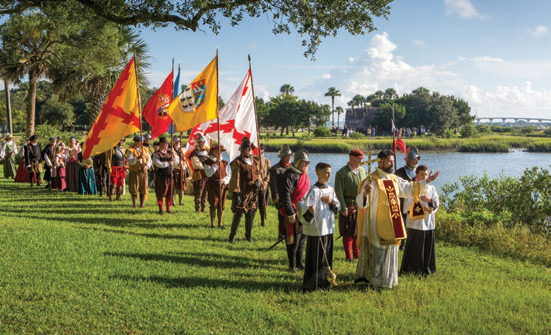
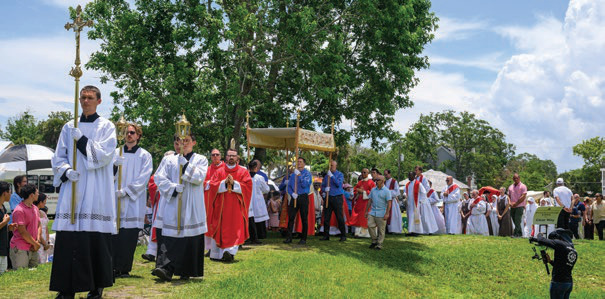
Historical reenactors portray Father Francisco López leading a procession as part of the first Mass of Thanksgiving, celebrated Sept. 8, 1565.
Many Catholics know the names Jamestown and Plymouth. Far fewer realize that the Catholic faith was present in what is now the United States long before those settlements.
That story begins here in St. Augustine.
On Sept. 8, 1565, Father Francisco López de Mendoza Grajales celebrated a Mass of Thanksgiving shortly after Spanish settlers arrived at La Florida with Pedro Menéndez de Avilés. The settlers processed to the site of the Mass in gratitude for their safe arrival and the founding of a new community.
Historians generally recognize this moment as the first Mass of Thanksgiving celebrated in a permanent European settlement in what would become the United States. An earlier Mass had been celebrated in Pensacola in 1559, but that settlement was short-lived and abandoned within two years.
What makes St. Augustine distinctive is not simply that the Mass took place here. It is that the community endured.
St. Augustine became the first permanent European-founded city in what is now the United States, and Catholic life established in 1565 continued through centuries of colonial change, conflict and cultural transition.
The parish of St. Augustine, today the Cathedral Basilica of St. Augustine, traces its roots to the founding of the city and is recognized as the oldest Catholic parish in what is now the United States.
There was a period when parish life was interrupted. From 1763 to 1777, when Florida was under British rule, Spanish clergy departed the territory. Some Catholics remained, but there were no priests to celebrate the sacraments. Catholic worship resumed when Minorcan settlers arrived in 1777 accompanied by Father Pedro Camps, who began celebrating Mass again in St. Augustine.
Another detail many people do not realize is the date of that first Mass. Sept. 8 is the Feast of the Nativity of the Blessed Virgin Mary. It is also the Feast of Our Lady of Covadonga, patroness of Asturias, Spain, the homeland of Pedro Menéndez de Avilés. In his diary, Menéndez referred to the day simply as “Our Lady of September.”
Over time, Marian devotion took root at Mission Nombre de Dios, where the Shrine of Our Lady of La Leche is recognized as the oldest Marian shrine in the U.S. For generations, pilgrims have come seeking the intercession of the Blessed Virgin Mary, especially couples praying for children and families asking for her maternal care.
As our nation approaches its 250th anniversary, this history offers an important reminder. The Catholic faith — centered on the Eucharist and devotion to Mary — was present at the earliest chapter of the American story.
That history is not simply something to remember. It is something we are called to carry forward.
Each time pilgrims come to Mission Nombre de Dios, attend Mass at the Cathedral Basilica, or pray at the Shrine of Our Lady of La Leche, they become part of a story that began more than 450 years ago — a story of faith that continues to unfold in our own time.